Blog > Step-by-Step Guide to Deploying Your CCTV Tower
Step-by-Step Guide to Deploying Your CCTV Tower
CCTV
Written by Kelvin DantonPublished: 19th May 2026Last update: 19th May 2026
CCTV Tower deployment is the process of transporting, positioning, and activating a mobile surveillance tower on a site to provide temporary or semi-permanent security coverage. It’s how you get a fully self-contained CCTV Tower set up and fully operational on your site, typically taking hours to complete (depending on the circumstances).
Mobile CCTV towers have become the standard security solution for construction sites, vacant properties, and infrastructure projects where permanent surveillance is not practical. Whether you are managing a six-month construction programme or protecting an empty building between tenants, understanding how deployment works helps you plan effectively and avoid delays.
This guide covers everything you need to know about installation of your CCTV tower, from the initial site survey through to activation and ongoing monitoring.
Contents
Key Takeaways
A security risk assessment should always be completed before a CCTV tower is deployed to identify threats, coverage priorities, and the best tower location.
Solar and off-grid power options mean towers can operate in remote locations without mains electricity or fixed infrastructure.
Professional CCTV monitoring and scheduled maintenance keep your coverage effective long after the initial deployment.
What prep work do we need before we deploy a tower?
Successful deployment starts before the tower arrives on site. Preparation reduces the risk of delays, repositioning, and gaps in coverage.
Start with a security risk assessment. Identify what you are protecting, whether that is plant and materials on a construction site, an empty commercial property, or critical infrastructure. A structured risk assessment highlights the specific threats your site faces and determines where surveillance coverage is needed most.
Survey the ground conditions. CCTV towers need a firm, level surface. Soft or uneven ground can compromise stability, particularly in wet weather. Check that the planned location can support the weight of the tower and that a delivery vehicle can access the site without obstruction.
Plan your power source. Mains electricity is the simplest option where available, but many sites lack a permanent supply. Solar-powered CCTV towers and off-grid systems can operate independently for extended periods, making them suitable for remote or temporary locations.
Check connectivity. Most modern CCTV towers transmit footage over 4G or 5G mobile networks. Before deployment, confirm there is adequate signal strength at your site. Weak connectivity can interrupt live monitoring and delay alert notifications.
Consider compliance. Under GDPR and the Data Protection Act 2018, you must display clear signage informing people they are being recorded. Your signage should include the purpose of the CCTV, the identity of the data controller, and contact details for enquiries.
How to Deploy a CCTV Tower in 5 Steps
Once your site is prepared, the physical deployment of a mobile CCTV tower follows a straightforward process. With a professional team handling the installation, most sites have full coverage within an hour.
Step 1: Position the tower
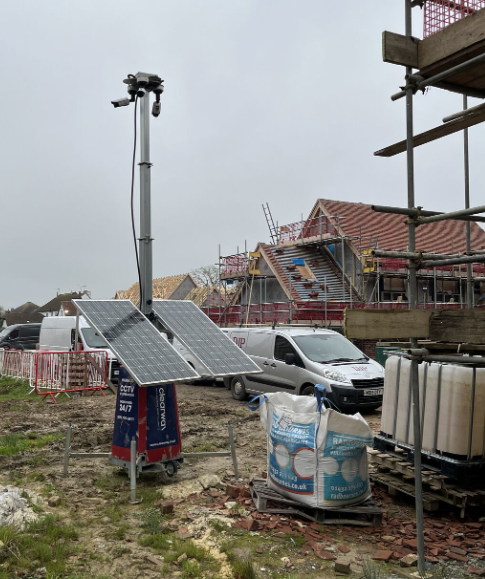
The tower is delivered to site and placed at the location identified during the site survey. Positioning takes into account camera sight lines, proximity to the assets being protected, and any environmental factors such as prevailing wind direction or sources of glare.
Step 2: Stabilise and level
Stabiliser legs are fully extended and locked into position. On softer ground, spreader pads are placed under each leg to distribute the weight. Each leg is adjusted individually using a winch handle until the tower is level, confirmed with the built-in spirit levels.
Step 3: Connect power and raise the mast
The power source is connected, whether that is mains supply, solar panels, battery units, or a combination. Once power is confirmed, the telescopic mast is raised to its full operational height, typically between 5 and 7 metres. During mast raising, all personnel should stand clear as a safety precaution.
Step 4: Configure cameras and detection zones
High-definition PTZ (pan-tilt-zoom) cameras are calibrated for the specific coverage area. Engineers set up motion detection zones to focus on entry points, perimeters, and high-value asset locations. AI-powered video analytics help distinguish genuine security events from false triggers caused by weather, wildlife, or passing traffic. Night vision and low-light capability is tested to confirm around-the-clock coverage. For a more detailed look at the technology involved, see our guide on how CCTV cameras work.
Step 5: Activate monitoring and verify
The tower is connected to an NSI Gold accredited monitoring centre for 24/7 remote surveillance. Live feeds, recording, and alert systems are tested. Engineers walk the site to verify that detection zones trigger correctly and that there are no blind spots. The site manager receives access credentials for the mobile app or desktop platform, providing live footage viewing and playback from any location.
Kelvin Danton
UK Sales Director (25+ years in deployable technology)
The most common issue we see is sites that have not been properly prepared before the tower arrives. Fifteen minutes spent checking ground conditions, access routes, and signal strength saves hours of repositioning later. When the groundwork is done right, deployment is fast and coverage is reliable from day one.
Discuss your CCTV tower deployment with Clearway
Every site has different requirements. Whether you need a single tower for a short-term project or multiple units across a large development, Clearway can advise on the right setup and manage the full deployment process on your behalf.
Even experienced site managers can encounter problems when deploying CCTV towers for the first time. These are the issues that most frequently lead to repositioning, coverage gaps, or operational downtime.
Skipping ground preparation. Placing a tower on soft, waterlogged, or uneven ground risks instability. In extreme cases, the tower may need to be relocated entirely, delaying your security coverage.
Insufficient coverage planning. Deploying a tower without first mapping out sight lines and coverage zones often results in blind spots. A thorough site survey before deployment ensures cameras cover every critical area.
Ignoring signal strength. Without adequate 4G or 5G coverage, the tower cannot transmit footage to the monitoring centre in real time. Always conduct a signal check during the site survey phase.
Forgetting GDPR signage. CCTV signage is a legal requirement. Missing or inadequate signage can result in regulatory action and may also undermine the evidential value of any footage captured.
Not integrating with wider site security. A CCTV tower works best as part of a broader security strategy that may include manned guarding, access control, and alarm systems. Deploying surveillance in isolation limits its effectiveness.
What Happens After Your CCTV Tower Is Deployed
Deployment is only the beginning. The ongoing value of a CCTV tower depends on consistent monitoring, regular maintenance, and the flexibility to adapt as your site changes.
24/7 remote monitoring. Footage from your tower is monitored around the clock by trained operators at an NSI Gold accredited centre. When a genuine security event is detected, the monitoring team can issue a live audio challenge, alert on-site security, or contact the emergency services.
Scheduled maintenance. Regular maintenance visits ensure cameras, solar panels, batteries, and connectivity equipment continue to perform. Preventive checks catch potential issues before they affect coverage.
Redeployment as your site evolves. One of the key advantages of mobile CCTV towers is that they can be relocated as your site layout changes. On construction projects, this means surveillance can follow the active work front rather than remaining fixed in one position. Clearway has deployed temporary solar CCTV on sites where no mains power exists, demonstrating the flexibility of modern deployable systems. You can also read about our approach to CCTV tower installations across a range of sectors.
For sites that need short-term coverage, CCTV tower hire provides a cost-effective alternative to purchasing equipment outright.
Deploy Your CCTV Tower with Confidence
Deploying a CCTV tower does not need to be complicated. With proper site preparation, professional installation, and ongoing monitoring, you can have reliable surveillance operational on your site within hours.
Clearway manages the full deployment process from initial site survey through to activation and 24/7 monitoring. Our rapid deployment CCTV towers are designed for fast setup, flexible positioning, and continuous off-grid operation, backed by NSI Gold accredited monitoring.
Contact Clearway to discuss your site requirements and arrange a survey.
FAQs
How long does it take to deploy a CCTV tower?
The total time depends on site conditions, the number of towers being installed, and whether solar panels or additional accessories need to be configured.
Do CCTV towers work without mains power?
CCTV towers can operate independently of mains power using solar panels, battery systems, or fuel cells. Solar CCTV towers are designed for remote or off-grid locations and can run for extended periods without an external power supply, making them suitable for sites where permanent electricity is unavailable.
Do I need permission to deploy a CCTV tower on a construction site?
You do not typically need planning permission to deploy a temporary CCTV tower on a construction site, as they are classified as temporary structures. However, you must comply with GDPR and the Data Protection Act 2018 by displaying appropriate signage and ensuring footage is handled in line with data protection regulations.
Can a CCTV tower be moved once it is deployed?
Mobile CCTV towers are specifically designed for relocation. The mast is lowered, stabiliser legs retracted, and the entire unit can be towed or transported to a new position on site. This makes them particularly effective for construction projects where the active area shifts over time.
Where should CCTV signage be placed when deploying a tower?
CCTV signage should be placed at every point where a person could enter the area covered by the cameras. Signs must be clearly visible and include the purpose of the surveillance, the identity of the data controller, and contact details. The Information Commissioner’s Office (ICO) provides detailed guidance on CCTV signage requirements.
With over 25 years of experience in the deployable technology sector, Kelvin brings a wealth of industry knowledge and a strong track record of delivering customer-focused security solutions across a wide range of environments. As UK Sales Director, he is committed to ensuring clients receive innovative, technology-led systems that not only meet immediate operational requirements, but also support long-term resilience, performance, and reliability.
Known for his hands-on and consultative approach, Kelvin works closely with clients to understand their specific site risks, operational challenges, and service expectations. His experience spans the deployment of temporary and rapid-install security technologies designed to protect people, property, and critical assets in dynamic or high-risk settings. This includes deployable CCTV towers, monitored surveillance systems, intruder detection, remote access solutions, wireless connectivity, power-managed equipment, and integrated site security designed for environments where permanent infrastructure may not be practical or immediately available.
Kelvin has a strong understanding of how deployable technologies can be used to provide effective coverage, rapid response, and real-time visibility across construction sites, vacant properties, utilities, infrastructure projects, and other remote or temporary locations. He recognises the importance of combining physical deterrence with intelligent monitoring, incident escalation, and data-led reporting to create solutions that are both operationally effective and commercially efficient.
At Clearway, this is supported by a focus on solution reliability, system performance, and service quality. Kelvin plays an important role in ensuring every deployment is aligned with Clearway’s standards for exceptional performance, dependable operation, and responsive customer support. Whether delivering standalone systems or integrated security packages, his priority is always to provide clients with practical, high-performing solutions backed by expert guidance and a strong service culture.
CCTV towers are a game-changer for monitoring vulnerable construction sites, outdoor environments and premises with large perimeters. They provide a movable, highly...
CCTV towers come in a range of models and functionalities designed for different functionalities, from inView devices to traffic management towers. CCTV...
CCTV towers provide rapid surveillance of construction sites owing to their size and visibility, quick deployment, 24/7 operations and ability to detect...
It looks like you’ve submitted your information in the wrong section of our website. No problem—if you’re looking to apply for a job, you can do so by viewing our current vacancies. Click below to find and apply for roles through the proper channel.